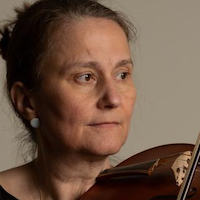
Susanne Scholz is an Austrian musician who has specialized in playing on historical violin instruments with focus on the repertoire of the Renaissance, Baroque and Classical period and in directing ensembles from the Renaissance consort to the opera ensemble.
In addition to her studies in Graz, Vienna (concert diploma violin) and The Hague (baroque violin), Susanne Scholz played in orchestras and with ensembles originated all over Europe and gained musical experience in performances around the world. Before she concentrated on planning, directing and playing her own ensembles and projects, Susanne Scholz dedicated most time to the period orchestras Les Arts Florissants (Paris) and La Petite Bande (Belgium).
Parallelly, since 1995, Susanne Scholz has been active as a teacher: in Vienna (MUK) she trained baroque violinists, taught ornamentation and developed and directed orchestra projects from 1995-99. In 1999 Susanne Scholz was appointed professor for Baroque violin, chamber music and baroque orchestra at the Hochschule für Musik und Theater Leipzig as the youngest professor in Germany. From 1999 to 2017 she took a decisive part in building up the Early Music Department at the HMT. In 2012 she followed a call to the University of Arts and Performing Art Graz (subsequently called KUG), firstly part-time alongside her activities in Leipzig, from 2018 she teaches exclusively at the Institute of Early Music and Performance Practice in Graz.
Besides her regular teaching activities, annual masterclasses around the world and her research connected to the performance practice relevant for violin instruments, Susanne Scholz has lectured during the last fifteen years all over the world.
Since 1999 Susanne Scholz directed numerous major opera productions, many of them as first modern-day performances, in Leipzig with operas by Sebastiani, Heinichen, Telemann, Bononcini, Förster and Hasse. She has also led major works by Vivaldi, Purcell, Campra, Stradella, Blow, Fux, Draghi and Lully. In these productions, Susanne Scholz directed the musical side of the productions from the concertmaster’s desk. Working together regularly with colleagues from all over Europe, she strives to demonstrate and pass on her passion for new questions in music practice and exploring new repertoire and how to convey this cultural richness to the audience.
More than 50 CDs testify to her artistic work, the implementation of her artistic research has led to very special CD productions together with her ensemble chordae freybergenses (works by A. Scandello on Renaissance violins) and with her chamber music partner Michael Hell on the harpsichord (sonatas op.V by A. Corelli, Sonatas and Balletti by Vitali, degli Antonii, Bononcini). Within her research project she is currently producing audio and video recordings with Carmen Leoni on the Clavichord (works by the sons and cousins of J.S.Bach).
Since her first contact with historical instruments, Susanne Scholz has connected her work to research, starting from musicological and organological studies to questions arising when applying the enhanced knowledge to her artistic practice. She has accumulated experience on many different violin instruments of all sizes and styles, relating the instruments most closely possible to the music chosen.
From 2003 she was part of the comprehensive research project concerning the musical instruments from before 1594 conserved in Freiberg cathedral headed by the museum for musical instruments Leipzig, leading the artistic research part connected to the five violin instruments. Following this involvement, she built up her ensembles chordae freybergenses and gamma.ut, took part in various symposiums, organized concerts and workshops in Belgium, the USA, Switzerland, Germany, Austria and Italy.
From 2018 to 2023 Susanne Scholz has worked on her doctoral project at the Doctoral School for Artistic Research at the KUG, dealing with the relevance of the Freiberg Renaissance violin instruments. Withing her researching she has published articles, produces audio and video material and carried out third-party funded project.
Since 2023 she has been leading a major research project funded by the Austrian Science Fund on sound production on early violin instruments (“The Restored Speech”) with a special focus on Renaissance violins.